Monday, May 5, 2008

of the things to be unraveled


picture: Square Navels, Erin Trapp
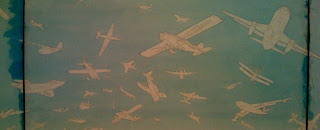
I have this idea for a children's book that would be about the unraveling of the world. The images that I think of are ones with lines unwhorling and flattening out, or becoming invisible. And all the textures and depths lessening.

Monday, March 31, 2008

out there

We did some gardening today. My mom has a wooden sign in her kitchen that reads, "gardening is cheaper than therapy." This is certainly true. And by this, I don't think that my mom has ever meant, "so you don't need therapy." It seems to be more a testament to her sense of a certain fluidity between psychic and social realities.

picture: from MOCA exhibit Collecting Collections, courtesy of the iphone camera of Becky Bowden.

Saturday, January 12, 2008

double language


there's already a lot going on this week. surprisingly, it has to do--in part, at least--with things i don't really have much context for. "Not knowing many things about a thing"--this type of knowledge is also always a pardon begged in relation to knowledge. It makes me wonder if we should ever hope to resolve such a thing. this lack of context is surprising because i thought that these things were continuities of things i had already been working with. like Spinoza, for example. But what were last year questions of ideology and the individual put to Hegel, are this year questions of belief, theology and the relation to the political put to Spinoza. Looking back at my notes, I find much of it unintelligible. what did make sense to me was Balibar's explication of the "double truth" as a strategy for speaking the universal. well, it did not actually make SO much sense in terms of speaking the universal, except that i think it is similar to Badiou's notion that the separation of spheres for science, art, love, and politics would allow non-interference between them. Spinoza is also similar to Wittgenstein, who wrote two dissimilar theoretical pieces during his life. So Balibar brings this question of authorship into the circle of things that there is to say about how Spinoza might be able to speak the universal. He concludes that the Political-Theological Tractatus is, minimally, a certain disguise of the author's opinions.

One of the things i very much like about the idea that the Political-Theological Tractatus is disguised in some way, or cryptic, in others, is that Balibar eschews the somewhat normed idea that censorship functions to hide those "real" or "true" elements that otherwise would not allow the text to get past the censor. Instead, he proposes that the genre of the tractatus is such that basic philosophical ideas fall under the cover of imaginative representations immediately accessible to the common ideas. With this style, Balibar concludes, "truth is not accessible in the same way." Similar to the "double truth" of the Spinozan and Wittgensteinian doctrines, language itself becomes doubled, and the prolbem with language is once again how to transform ideas to representations and truths to opinions (held by many). So it is, language.


Picture: from The History of Egypt, "The Occupations of Ani in the Elysian Fields" followed by text "...in the Great Hall of the Double Truth, who have no falsehood in your bosoms, but who live on Truth in Aûnû, and feed your hearts upon it before the Lord God who dwelleth in his solar disc."

Friday, November 30, 2007

blind contours


These blog writings began as things that could not be included in my dissertation. i suppose at some point, my feelings about the dissertation began to change. i think at this time, the content of what was included here also changed. though the dissertation is hopefully changing in positive ways, what is here is not. and that is largely because there is very little here. this is very sad to me. at the same time, the fact that there is not very much here seems to be one of the phenomena that i am trying to explain in my dissertation. i am writing about how poetry is able to theorize about political activity. one of the outcomes of this is that i am able to see and to say how poetry can engage in political action. in the first chapter, which deals with the Bertolt Brecht, i suppose i am trying to see how poetry sees its removal from the realm of politics, and how Brecht theorizes its return. one of the consequences of this removal from politics is the loss of external reality. by external reality, i mean things that are registered as belonging to the world--the "many-sided world," according to Brecht. i feel like not being able to write things in this blog is related to the loss of external reality, of my external reality. i think this relationship--that is, to external reality--is always very tenuous anyways. i think it takes a lot to maintain it, but the "work" of its activity is not always that clear. in fact, i think the work is downright murky; it is dark.

One of the things that has made the dissertation writing go better is that i am slowly realizing how slowly i need to proceed in order to present an intelligible argument. sometimes i am surprised at how "beyond me" this has seemed. i have begun to think that this process is somewhat like drawing blind contours. i have held onto this practice for quite some time, since high school, i think. the task is to move your pen as slowly as your eyes trace the object you are drawing, not looking at your paper until you have finished tracing the whole object. what results is, of course, never realistic, but it is rare that the object that is traced is not at all intelligible on the paper. i have never grasped the idea, exactly, that in writing, my pen might have to move as slowly. the value of the patience of sticking with it blindly to end goes without need to say more. so perhaps that is something

Tuesday, October 30, 2007

the lost posts


As my "Humanities Core" (http://www.humcoretrapp.blogspot.com/) blog threatens to overtake "Zoo" in sheer number of posts, as November begins, as the pressure to finish chapter one increases, and as i get used to idea that the letters are still not about love... as all these things, I really hope that I am picking up again, on these postings. Even with this, there is the sense of loss and redemption, and perhaps this where to begin. I had come to the conclusion that redemption is what Brecht wanted to thwart through his development of anti-aristotelian theater.


In "Alienation Effects in Chinese Acting," Brecht's 1936 [1949] essay relating his observation of Mei Lan-fang's theater company in Moscow to his development of the estrangement-effect, Brecht's concerns seem primarily to involve what we have come to understand as consciousness-raising. It seems possible find in hte essay the repetition of a call for consciousness. From the beginning, he writes: "The efforts in question were directed to playing in such a way that the audience was hindered from simply identifying itself with the characters in the play. Acceptance or rejection of their actions and utterances was meant to take place on a conscious plane, instead of, as hitherto, in the audience's subconscious." It follows, therefore: all of the readings of his didacticism, his empiricism, his objective reality, his undeserved greatness... all of these things deal with and assert the primacy of the "conscious plane" to Brecht.


The interesting part of this process seems to be the way in which "identifying with" the actions subconsciously becomes Brecht's shorthand for the way that theater, and art in general, has functioned since Aristotle. It is what Leo Bersani has called "the culture of redemption," what Benjamin saw as the messianistic, what myths of "primitive accumulation" allow, and, as Savvy T and I discuss endlessly, it is the predominant justification and grounds for the production and study of literature. Or is it itself an uninvestigated, assumed uncritical blah blah blah ideology? But this percolating idea about Brecht's non-redemptiveness is that art, for Brecht, does something other than affirm (positively or negatively) the adequacy of the relationship between form and content (which, for Aristotle, is intricately related to the interdependency of the soul and the body), that before art conveys the coincidence of form and content (something accidental?), it does something else: this is the question that it seems even the very consideration of involves the willingness "to suspend belief."

Picture: Cozydan t-shirt design. thanks to Becky for buying.

Friday, October 12, 2007

identity threat


Craters of the Moon National Monument: where the "them" are spatter cones.
Talking with friends last night about irony (thanks to Alanis Morisette for providing the the procative lyrics that were inspiration for the conversation—something about rain and wedding day), we struggled to define irony itself. This arose from the observation that the incidents Morisette mentions do not qualify as irony because they do not involve the thwarting of intention and are instead just “bad things” that happen. It seemed that, in some way, the not knowing had to be related to intention--as if the incongruity between what was expected and what actually happened needed, nonetheless, an active agent. What is irony with this idea that in some way, without your knowing, you contribute to your downfall?

Monday, October 1, 2007

not making waves

If the "hard things do give way," as Brecht wrote, it is hardly a reassurance, although it is one that Benjamin holds onto, and esteems, when he speaks of Brecht. We might be inclined to want this--the passing away of tension, the eventual ease of transformation, the hopeful sense that change is endless--but with Brecht, one does not dwell with this too long. More than the sense that things can change (and counter to the obvious rendition of "change, not mere interpretation"), Brecht seems to find that the sense of "being otherwise" depends upon a tenuous perception of the difference between the rules that govern and the society that persists. The insight here is perhaps not so profound, but what I think Brecht offers is the idea that art is not there to change or even to reflect the possibility of change, but that art is there to maintain this tenuousness. What is the work of maintaining this disjunct, one that might be seen to correspond to the inadequacy of the relationship between content and form, or between reality and representation?

Saturday, July 28, 2007

inside joke, outside job


How people decide whether or not it matters to be on the inside (and then what inside) or the outside is a matter of passion, of Leiden, of suffering. It follows from such a description (in which choice is not so much an action, or an act, but rather something that acts upon you) interiority and exteriority are related to affect, or to the exchange of activity and passivity. The exchange of interior and exterior, or the blurring or solidification of each sphere, seems to fixate nonetheless on the boundary in between rather than the logic involved in their obversity in the first place. This contrasts with our attention to the substantive realms of subject- and objecthood when we fixate on what distinguishes the one from the other; instead, their relationship seems figured by a "determining" logic that persists (or is blurred or solidified) between them. In fact, it seems kind of arbitrary to say that this type of distinction, between the contours of interiority/exteriority and the substantiveness of subject/object, holds. Figures of the encounter between the subject and an other have sought to capture the gesturality and ephemerality, the mutual constitutivenss of the subject by the other, and of the object-world or environment in which she finds herself, in an effort to rethink the ontological status of the subject and its other. But the question that such a juxtaposition seems to present to me at this point has to do with the desire to even think of the pairs of interiority/exteriority and subject/object as analogous, or minimally, as fitting comparisions.

Tuesday, July 24, 2007

lost lust: before Freud


In Exhausted Modernity, Teresa Brennan notes that though Freud’s pleasure principle might be criticized for its economic (quantitative) aspects, discussion tends far less towards its descriptive characteristics, the type of phenomena that it qualifies. For Brennan, this quality is instant gratification, one that relates to the commodity form. She writes, “[m]oreover, if one reconsiders the desires implicit in commodities, it will be plain that while the pleasure principle accords with the desire for instant gratification that they express, and with their visual presentation in various media, it does not account for the other desires revealed in their design, namely: the desire to be waited upon; the desire to believe one is the source of agency who makes it happen; the desire to dominate and control the other who is active in providing, but whose activity is controlled by a relatively passive director, and the aggressive desire towards the other, if we take pollution as evidence of aggression” (23). Brennan's summary of the forms of latent desire registers the complications of knowing or seeing the factors involved in circulation; these unaccounted for desires or pleasures are what Freud calls “forepleasure,” which he uses to describe the various pleasures of infantile sexuality, jokes, creative, and stage-acting, is “the pleasure that serves to initiate a large release of pleasure.”[1] I want to explore the notion of desires that don’t “count” or can’t be quantified as forms of circulation. One form of this question is how we enter (voluntarily) into circuits that we also suffer from, which is also a question of the translation of passivity (or passions) into activity (or actions). Brennan's observations of latent desires reveal that there is a utility to passions that are not as immediate willful agency. Freud's mentions of preconscious pleasure generally become subsumed in the unconscious, but I would like to extend Brennan’s observations of this affective realm that is “beyond” circulation, exchange, and pleasure by examining the aesthetic principles that are behind these dynamics.

Freud’s citation of these dynamics often refers to the work of G.T. Fechner, whose work on psychophysical phenomena is seen as the basis of Freud’s economic and energetic principle of constancy. Fechner is perhaps less known for his two-volume work, The Primer of Aesthetics, but it here that he develops the notion of “forepleasure”; describing the contribution of multiple factors “without contradiction,” Fechner develops a notion of the aesthetic that comes from this transformation of passive factors into activity. Freud describes this as an aesthetic in Jokes and their Relation to the Unconscious not he did in Project for a Scientific Psychology as “relating to sensation or perception,” but as “deriving pleasure from its own activity” (emphasis mine). Freud's rough, apologetic definition of the aesthetic presents the possibility that the causes of aesthetic pleasure are obscure, but this autonomy is generally revoked for a more certain, unconscious empirical, one which is easily quantifiable and whose circulation is registered at a conscious level. In this extension, I move to exploring the aesthetic underside of this desire for a scientific basis, places where the aesthetic might betray its scientific intention.

Monday, July 9, 2007

forms of vor

In his essay "Comittment," Adorno describes the tension between didactic and non-political art, and labels art that is itself and no other thing "pre-artistic." This designation signals a realm outside of the tension (and perhaps also relationship) between subject and object.

Adorno writes: “The notion of a ‘message’ in art, even when politically radical, already contains an accommodation to the world: the stance of the lecturer conceals a clandestine entente with the listeners, who could only be rescued from deception by refusing it. […] But any literature which therefore concludes that it can be a law unto itself, and exist only for itself, degenerates into ideology no less. Art, which even in its opposition to society remains a part of it, must close its eyes and ears against it: it cannot escape the shadow of irrationality. But when it appeals to this unreason, making it a raison d’etre, it converts its own malediction into theodicy. Even in the most sublimated work of art there is a hidden ‘it should be otherwise’. When a work is merely itself and no other thing, as in a pure pseudo-scientific construction, it becomes bad art—literally pre-artistic.” (Adorno, "Comittment" 193-194)

The equation between bad art and the "pre-artistic" is compared to the non-referentiality of a pseudo-scientific "construction," something that does not have the verifiability of organic replication, perhaps. Adorno's construction of the problem of art in this manner introduces the tension subject and object into the field of artistic creation. I think something like the struggle between the individual, human world and the collective, social world can be sensed here; it is this anxiety that overpowers what for Adorno seems to be the real danger. The real danger seems to also need some signification that the "times" which the artwork opposes are also, in some way, exceptional--perhaps, as Adorno would say, damaged. From this, Adorno can go on to say that the problem of the "message" is its "accomodation" to the world, and can use the force of the tension between the subject and the object to differentiate art that accomodates from art that says "otherwise." The tension between the subject and the object is what Adorno, in other places, describes as "form." Here, he merely says that when this tension is not strong enough, there is no "art," or worse, that there is "bad art"--that this realm of not art is "pre-artistic." Here--when we are talking about what counts as art (vs. what is pre-artistic)--the stakes of judging good and bad are revealed, since form can seem to hinge on something as flippant and finnicky as taste.